
How to Choose an Asian Food Wholesale Supplier: A UK Buyer’s Guide
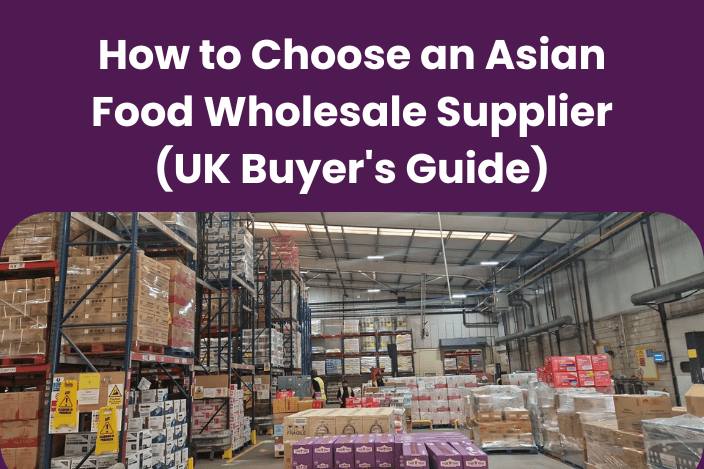
Your supplier list is one of the most important decisions you make as a trade buyer. Get it right, and your kitchen runs on consistent, authentic ingredients at margins that work. Get it wrong, and you are firefighting stockouts, swapping recipes mid-service, and explaining price rises to your own customers.
This guide is written for the people doing the buying — wholesalers, distributors, restaurant and takeaway operators, caterers and foodservice managers — who need a dependable source of bulk Asian ingredients. It walks through what actually separates a good Asian food wholesale supplier from an average one in the UK, the criteria worth scoring suppliers against, and the questions to ask before you commit a single order.
Wholesaler, distributor or cash & carry — know what you are buying from
“Supplier” covers several different models, and they are not interchangeable. Before you compare names, get clear on which type fits your operation.
Wholesalers and distributors supply trade customers in bulk, usually on a trade account with delivery. Many UK buyers search for asian food wholesale distributors uk specifically because they want a single partner who carries depth across multiple cuisines and brands, delivered to the door, rather than a one-line specialist (we explain how this works in our guide to Asian food distribution in the UK). This is normally the right model for kitchens and resellers who order regularly and want price stability.
Cash & carry suits buyers who want to hand-pick stock in person and collect the same day. It offers flexibility but usually means your own time, your own transport, and pricing that is less predictable across visits.
Importers and brand owners sit upstream. Buying direct can lower unit cost on a single line, but rarely makes sense unless you move serious volume of one product, because you lose the convenience of a consolidated order.
For most trade buyers, a wholesale supplier that consolidates ambient, chilled and frozen Asian lines into one delivered account is the most efficient choice. The rest of this guide assumes that is what you are evaluating.
The criteria that actually matter
It is easy to choose on the headline price alone. The buyers who protect their margins year-round look wider. Here are the factors worth scoring every candidate against.
1. Range and authenticity
A strong Asian food wholesale supplier should let you build most of a menu from one order — rice and noodles, sauces and pastes, oils, dried goods, spices, and the regional staples that define Chinese, Thai, Japanese, Korean, Vietnamese and Indian cooking. Breadth matters because every extra supplier you add is another invoice, another delivery window and another point of failure. It is worth scanning a candidate’s full product range before you commit, to see how much of your order list one supplier can actually cover.
Authenticity matters just as much. Diners and your own trade customers notice when a curry paste or a soy sauce is the “near enough” version. Look for a supplier that carries recognised regional brands, not just generic substitutes, so the dishes leaving your kitchen taste the way they are meant to.
2. Consistent supply and stock depth
Range is worthless if the lines you depend on are routinely out of stock. The single most damaging thing a supplier can do is force you to change a recipe because their shelf is empty. Ask how deep their stockholding is on core lines, how they manage seasonal or imported items prone to shortages, and what their fill rate looks like in practice. A supplier backed by established import relationships and a real warehouse operation will hold consistency far better than a thinly stocked reseller.
3. Pack sizes and minimum order quantities
The right pack size depends on your throughput. A busy takeaway burns through a 20kg sack of rice quickly; a small café will see it spoil before it is used. A good supplier offers a sensible spread of pack sizes and case quantities, and is upfront about minimum order quantities (MOQs) and minimum order values for free or discounted delivery. Match these to your storage and turnover before you sign up — over-ordering ties up cash and risks waste; under-ordering pushes up your per-unit cost. Our guide to bulk buying Asian ingredients for foodservice profit goes deeper on getting this balance right.
4. Trade pricing and transparency
Bulk buying should reward you with genuine trade pricing, not a thin discount on retail. Ask for a price list against the lines you actually use, and look for transparency: clear unit costs, no surprise surcharges, and a sensible approach to price changes on imported goods. The cheapest list on day one is not always the best value over a year — consistency and honesty about pricing usually matter more than a single low number. For more on how sourcing decisions feed into margin, see how UK restaurants can reduce food costs through Asian ingredient sourcing.
5. Provenance, food safety and compliance
Whatever you serve, the responsibility for what is in it runs back through your supply chain. A credible wholesale supplier should be able to evidence food-safety standards, full traceability on imported goods, and clear, accurate allergen information on every line. If a supplier cannot quickly tell you where a product comes from and how it is handled, that is a risk you are inheriting. This is non-negotiable for caterers and any operator serving the public.
6. Delivery, lead times and coverage
Check the practicalities early: which days they deliver to your area, cut-off times for next-day or scheduled delivery, how chilled and frozen lines are kept in temperature through transit, and what happens when something is short or damaged on arrival. Reliable cold-chain handling and a dependable delivery schedule are what let you plan your own kitchen with confidence.
7. Account support and ease of ordering
Day to day, you want ordering to be simple — a clear online or account-managed process, easy reordering of your regular lines, and a real person to call when something needs sorting. A responsive account team is worth a great deal when you are mid-service and an order has gone wrong.
8. Heritage and stability
Finally, look at how long the business has been in the trade and who stands behind it. Longevity is a proxy for the things that are hard to see from the outside: solid import relationships, financial stability, and the operational experience to keep supplying you through disruption. A supplier that has weathered decades of changing tastes and supply shocks is a safer bet than one that appeared last year.
Red flags to watch for
- Vague provenance. If they cannot tell you the origin or handling of a product, walk away.
- Constant substitutions. Frequent “we’re out, here’s an alternative” messages signal weak stock control.
- Opaque pricing. Hidden surcharges, unclear MOQs, or prices that move without explanation.
- No trade structure. A genuine wholesale supplier has a proper trade account process, not a retail checkout with a discount code.
- Thin range. If you need three suppliers to cover one menu, your admin and risk multiply.
Questions to ask before you open an account
Use this as a quick checklist when you speak to a prospective supplier:
- What is your full range across ambient, chilled and frozen Asian lines?
- Which brands do you carry on the products I use most?
- What pack sizes and MOQs apply, and what is the minimum order for free delivery?
- Can I see trade pricing on my actual order list?
- How do you evidence food safety, traceability and allergen information?
- Which days do you deliver to my postcode, and what are your cut-off times?
- How do you handle shortages, damages and credits?
- Can I place a smaller trial order before committing to regular volume?
A supplier worth your business will answer all of these without hesitation.
Where Tiger Tiger Foods fits
Tiger Tiger Foods is a UK trade supplier of bulk Asian food, built specifically for wholesalers, distributors, restaurants, takeaways, cafés and caterers — not for home cooks. The range is designed to let trade buyers source the staples and authentic regional brands behind Chinese, Thai, Japanese, Indian and wider Asian menus from a single account.
The part that is hardest for newer suppliers to match is heritage. Tiger Tiger Foods is backed by JK Foods, a business with around five decades in the UK Asian food trade. That depth sits behind the import relationships, stockholding and reliability that the criteria above are really testing for — the difference between a supplier who can keep your core lines on the shelf and one who hopes to.
If you are weighing up Asian food wholesale suppliers in the UK, the practical next step is to put a candidate to the test against your own order list.
Ready to compare us against your current supplier?
The best way to judge a wholesale supplier is on your own products and volumes. Open a trade account with Tiger Tiger Foods, browse the full product range, and check our pack sizes and trade pricing against what you buy today.